
Pet-Friendly Flooring for Asheville Dog Owners: Scratch-Proof, Waterproof Options That Look Great
- jeremy186
- Mar 1
- 7 min read
Asheville is one of the most dog-friendly cities in North Carolina. Dog parks, pet-friendly restaurants, trails in the Blue Ridge — dogs are part of the lifestyle here. That lifestyle, though, has real consequences for your floors. Nails on hardwood, accidents on carpet, muddy paws tracked in from a French Broad River walk — it adds up.
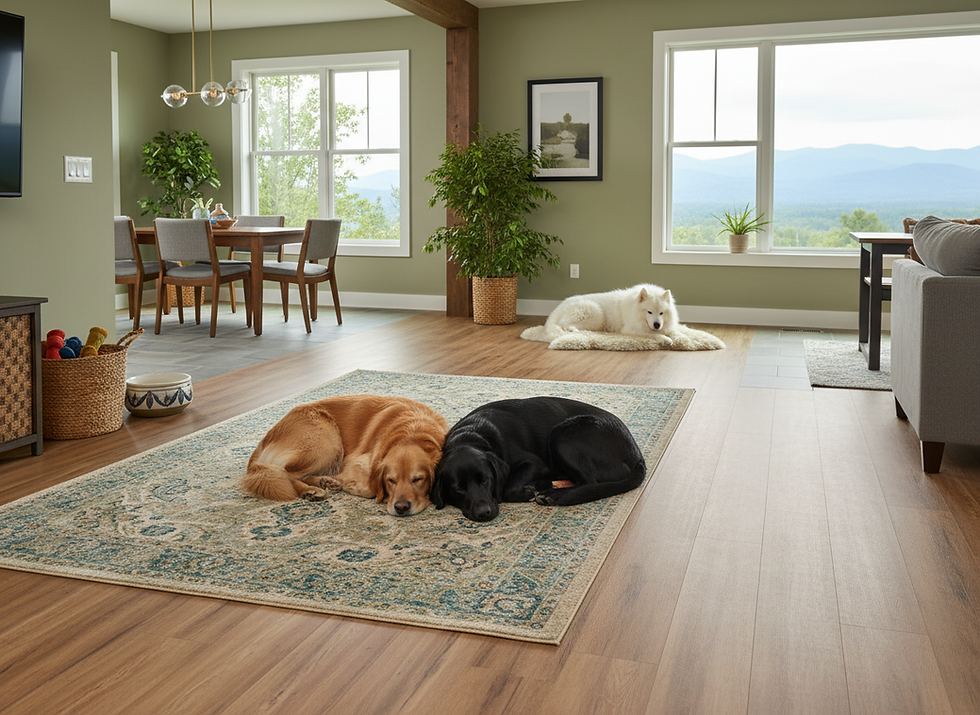
The good news is that choosing pet-friendly flooring doesn't mean sacrificing style or living with institutional-looking materials. The flooring options available today handle pets remarkably well, and the gap between "practical" and "beautiful" has essentially closed.
This guide covers what to look for, which flooring types perform best with dogs and cats, and how to make a choice that works for both your family and your four-legged household members.
At One Stop Flooring Shop, we've helped hundreds of Asheville pet owners find flooring that holds up beautifully. Schedule a free in-home consultation and we'll bring samples to your space.
The Two Main Challenges: Scratches and Moisture
Pets create two distinct flooring problems that require different solutions.
Scratches come from nails on hard surfaces. Dog nails are the primary concern — larger dogs with longer nails are especially hard on floors. Cat nails can scratch softer surfaces but are less of an issue in high-traffic areas since cats typically stay on furniture.
Moisture comes from accidents, water bowl spills, and wet paws. This is the more serious long-term issue because moisture damage — warped boards, stained subfloors, mold in padding — is harder and more expensive to remediate than surface scratches.
A genuinely pet-friendly floor needs to address both. Here's how the main flooring categories stack up.
Luxury Vinyl Plank (LVP): The Best Overall Pet Floor
LVP is the clear winner for pet households. It handles both moisture and scratches better than any other product at its price point, and it looks convincingly like real hardwood.
Scratch resistance: Depends heavily on wear layer thickness. For pet households, 20 mil wear layer is the minimum — this is the spec that handles dog nails in real-world use without showing scratching within months. The 12 mil products you'll find at the lower price points will show nail marks in high-traffic areas within a year or two with medium to large dogs.
Moisture resistance: LVP planks are 100% waterproof. A dog accident cleaned up within a reasonable time won't penetrate the planks at all. The caveat is seams — standing water that sits long enough to seep beneath the floor through seams can affect the subfloor. Prompt cleanup matters.
Look and feel: Modern LVP products look genuinely like hardwood. Wide-plank formats with embossed-in-register textures are indistinguishable from real wood to most observers.
Maintenance: Easy. Dry mop or vacuum to remove hair and grit (which acts like sandpaper on the wear layer if left), damp mop with a pet-safe cleaner as needed.
Our blog post on how to choose pet-friendly flooring covers LVP in detail alongside other options. For our full LVP lineup including Coretec, Karndean, and Shaw, visit our LVP page.
Tile: The Most Durable, Most Hygienic Option
Porcelain tile is essentially impervious to pet damage. Dog nails can't scratch it. Accidents clean up with a mop. It won't stain. It won't absorb odors over time the way carpet does.
The trade-offs are comfort and temperature. Tile is hard and cold underfoot — fine in a kitchen or bathroom mudroom, but most people don't want tile in their bedroom or family room. In Asheville's colder months, bare tile in a living area is notably uncomfortable.
Tile is the ideal choice for mudrooms and entryways specifically — the spaces where wet dogs come in from outside, where water bowls sometimes overflow, and where boots and muddy paws track in constantly. For that application, it's hard to beat.
See our tile flooring page for the full range of porcelain options we carry, including Crossville, Dal Tile, and Happy Floors.
Hardwood: Beautiful but Vulnerable
Let's be direct: hardwood floors and dogs are a difficult combination, and how well it works depends entirely on the species, finish, and the specific dogs involved.
Species hardness matters significantly. The Janka hardness scale measures resistance to denting and surface damage. Hickory (1,820 Janka) stands up to dog nails far better than walnut (1,010 Janka). White oak (1,360) is the middle ground that most Asheville homeowners choose — hard enough to resist everyday nail marking while still having the natural character that makes hardwood worth the investment.
Finish also matters. Oil-finished and wire-brushed hardwood hides scratches better than high-gloss polyurethane because the texture and low sheen disguise surface marks. A satin or matte finish is more forgiving of everyday pet wear than a glossy finish that shows every mark.
The accident issue. This is the critical vulnerability. Dog urine on hardwood, if not cleaned immediately, penetrates the finish and stains the wood. Repeat accidents in the same spot will blacken and damage the wood beyond refinishing in that area. If you have a puppy in training, a senior dog with bladder issues, or any dog prone to accidents, hardwood is a genuine risk.
For Asheville pet households committed to hardwood, our full guide on hardwood flooring in Asheville covers species selection and finish options that minimize the impact.
Carpet: High Risk, High Comfort
Carpet is the most comfortable option underfoot but the most challenging for pet households.
Nails: Not an issue for short-pile carpet, but loop pile (including Berber) is vulnerable to nail snags that pull loops out and create visible damage.
Accidents: The biggest problem. Pet urine soaks through carpet into the pad and eventually into the subfloor. Surface cleaning doesn't reach the pad — what you're smelling after cleaning is usually the contaminated pad, not the carpet surface. In serious cases, the pad and subfloor require treatment or replacement in addition to the carpet.
Odors: Carpet absorbs and holds pet odors over time in a way that hard flooring doesn't.
If carpet is important in your home — for bedroom warmth and comfort, for a kids' playroom, for sound insulation — choose cut-pile carpet in a solution-dyed nylon or triexta fiber. Both resist staining better than other fiber types. Avoid loop pile if you have dogs.
Keep pets off carpeted areas with an accident-prone history until training is reliably established. See our carpet page for fiber and construction options that minimize pet-related risk.

Laminate: Better Than Hardwood, Worse Than LVP
Laminate's position in the pet-flooring hierarchy falls between hardwood and LVP. Its wear layer provides better scratch resistance than most hardwood finishes, but it lacks LVP's waterproof core. Moisture that penetrates seams causes the same swelling and delamination that plagued older laminate products.
Waterproof laminate has improved this picture — sealed edges prevent the most common moisture intrusion point — but LVP still offers better overall moisture performance at similar or lower price points. For most pet households, LVP is the stronger choice over laminate.
That said, for a home office or bedroom where the pet is large but the moisture risk is low, a quality laminate with a 20+ mil wear layer handles scratches well.
What to Look for When Choosing Pet Flooring
For scratches:
LVP: 20 mil wear layer minimum; 28 mil for large dogs with long nails
Hardwood: Hickory or white oak in a matte or satin finish; avoid soft species
Laminate: AC4 rating minimum
For moisture:
LVP is the primary recommendation for any area with moisture risk
Tile for entryways, mudrooms, and anywhere a dog has regular access to water
Carpet only in low-moisture areas with fiber types that handle spills well (solution-dyed nylon, triexta)
For cleaning ease:
Tile and LVP are the easiest to maintain; both clean with standard mopping
Hardwood requires more careful moisture control during cleaning
Carpet requires vacuuming with a pet-hair attachment plus periodic professional cleaning
The Asheville Factor: Outdoor Dogs and Mountain Mud
Dogs in Asheville go outdoors more than dogs in many urban environments. Trails, parks, mountain hikes, muddy off-leash areas near rivers — Asheville dogs track in more debris, more mud, and more moisture than their urban counterparts.
This makes the entry-level flooring decision particularly important. A tile or LVP mudroom or entry zone before your main living area flooring begins is one of the most practical decisions an Asheville pet owner can make — a transitional space where dogs get dried off before reaching hardwood or carpet.
Frequently Asked Questions
What's the single best flooring for a household with two large dogs?
LVP with a 20 mil wear layer in SPC construction covers all the bases — scratch resistance from the wear layer, waterproofing for accidents, easy cleaning, and a realistic wood appearance. Coretec, Karndean, and Shaw all make excellent products in this category. Our team can show you specific options during a free in-home consultation.
Can dog scratches in hardwood be fixed without replacing the floor?
Light surface scratches in hardwood can be addressed with floor cleaner and touch-up kits. Deeper scratches and widespread marking require professional sanding and refinishing. If a floor has significant pet damage, refinishing is almost always more cost-effective than replacement — but there's a limit to how many times a floor can be refinished.
My dog has accidents at night. What flooring is safest?
For a dog with regular accidents, LVP is the only hard flooring where accidents won't cause lasting damage to the floor itself (though they still need prompt cleanup to protect the subfloor at seams). In any carpeted area with a repeat-accident dog, the pad and potentially the subfloor are at risk regardless of how quickly you clean the surface.
Does pet dander affect flooring choice?
Pet dander accumulates more in carpet than on hard flooring. If anyone in the household has allergies, hard flooring throughout main living areas is generally recommended, with area rugs that can be washed if desired.
See Your Options at Our Asheville Showroom
Our showroom at 367 N. Louisiana Avenue carries samples from our complete LVP, hardwood, tile, and carpet lines. We can show you wear layer comparisons, demonstrate scratch tests on different products, and help you think through what works for your specific household.
Book your free in-home consultation and we'll come to your home, see your space firsthand, and give you specific recommendations. Call 828-505-1267 or request a quote online.


Comments