
Discount Flooring Quality Guide: What Asheville Homeowners Need to Know Before They Buy
- jeremy186
- Feb 28
- 10 min read
Top TLDR: Discount flooring can match the durability and quality of full-price products when you understand what's actually being discounted. This guide covers lifespan data by material type, warranty terms, and how to spot a quality floor before you buy. If you're shopping for flooring in Asheville, NC, the key takeaway is to ask whether you're looking at overstock, discontinued, or seconds before assuming the price reflects the quality.
Discount flooring gets a bad reputation it mostly doesn't deserve. Walk into any big-box store and you'll see clearance tags on products that are virtually identical to what's sitting at full price two aisles over. The difference? One roll ended a production run. The other didn't.
But it's a fair question to ask: if the price is lower, what's the catch? For most Asheville homeowners, the answer is nothing, as long as you know what you're buying and how to check it.
This guide covers everything from lifespan data by material type to what discount flooring warranties actually say, so you can shop confidently and avoid the few situations where a deal isn't really a deal.
How Durable Is Discount Flooring? Lifespan Data by Material Type
Durability isn't determined by price. It's determined by material composition, wear layer thickness, and installation quality. When flooring goes on clearance, none of those things change.
Here's what real-world performance looks like across the flooring types you'll find at a discount:
Luxury Vinyl Plank (LVP): LVP is one of the most popular discount finds because manufacturers frequently overproduce it. A quality LVP product carries a wear layer measured in mils (thousandths of an inch). Residential-grade LVP typically has a 12-mil wear layer, while commercial-grade runs 20 mil or higher. With proper care, LVP lasts 15 to 25 years. Discount LVP from brands like Shaw, Mohawk, and Coretec carries the same wear ratings at clearance price as it does at retail. The floor doesn't know it was discounted.
Hardwood: Solid hardwood can be refinished multiple times and routinely lasts 50 to 100 years. Engineered hardwood, which holds up better in humid environments (important in Western North Carolina), has a lifespan of 25 to 30 years depending on veneer thickness. Discount hardwood is almost always overstock or discontinued color from the same mills producing full-price product. The wood itself is identical.
Laminate: Modern laminate is built with an AC rating system (AC1 through AC5) that tells you exactly how much traffic it can handle. AC3 is standard residential, AC4 handles heavy residential or light commercial, and AC5 is commercial-grade. Discount laminate carries the same ratings. Expect a 15 to 25 year lifespan under normal use.
Tile: Ceramic and porcelain tile are essentially permanent if installed correctly. They're rated by the Porcelain Enamel Institute (PEI) for foot traffic, and a PEI 3 or higher is suitable for most residential floors. Discount tile from manufacturers like Dal Tile, Crossville, and Florida Tile maintains these ratings regardless of price. Grout and installation quality matter far more than whether the tile was full price.
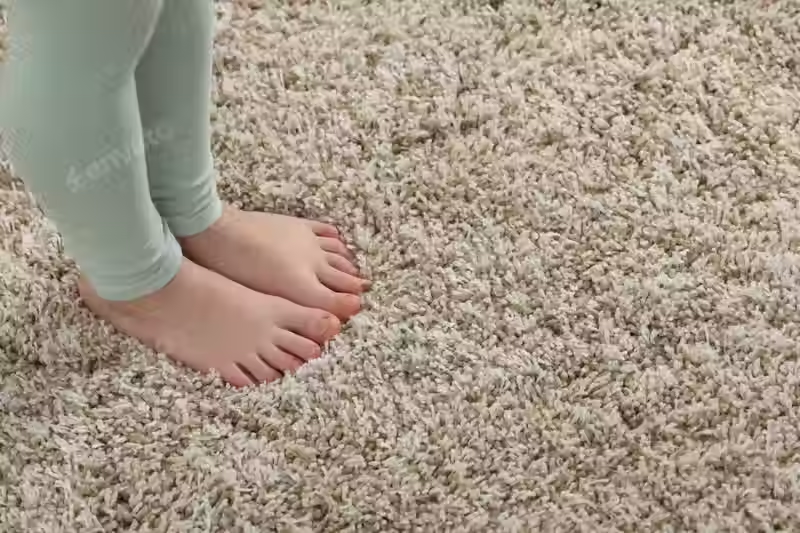
Carpet: Carpet lifespan ranges from 5 to 15 years depending on fiber type, pile density, and how much foot traffic it gets. Face weight (ounces per square yard) is the most reliable durability indicator, not price. Discount carpet from brands like Mohawk and Dream Weaver often comes from dye lot closeouts or production overruns, with no change to the fiber construction.
If you want to compare flooring materials in more depth, the products page at One Stop Flooring Shop gives a clear breakdown of the brands carried across all flooring types.
Clearance vs. Seconds vs. Overstock: Understanding Discount Flooring Categories
Not all discount flooring is discounted for the same reason. This is probably the most important thing to understand before you buy, because the reason behind the discount tells you a lot about what you're getting.
Overstock: The manufacturer or retailer ordered more than they could sell. The flooring is first-quality, meets all specifications, and is being moved out to make room. This is the best possible discount scenario. You're getting exactly what full-price customers get, just with better timing.
Discontinued: A color, style, or product line has been phased out. The flooring itself is first-quality. The only real concern here is that if you need to replace a section later, you may not be able to match it exactly. This matters less for tile (which can be stored easily) and more for hardwood or LVP where a seamless repair might matter.
Seconds: This is the category to watch. Seconds refers to flooring that didn't pass visual inspection but is still structurally sound. It might have a color variation, a minor surface scratch, or a slight inconsistency in the pattern. For large rooms, small visual imperfections tend to disappear across the full install. For accent areas or small rooms where every plank is visible, you'll want to inspect more carefully. Seconds are always sold as-is, so know what you're looking at before you commit.
Builder's Grade: Sometimes marketed as a discount, builder's grade flooring is simply a lower-specification product, not a discounted version of a better one. It's not necessarily a bad option, but it's not the same as buying a premium product at clearance. Read the specs, not just the label.
Discount Flooring Warranties: What's Actually Covered?
This is where discount flooring can genuinely differ from full-price product, and it's worth understanding the distinction.
Manufacturer warranties cover defects in the product itself. If you're buying overstock or discontinued flooring, the manufacturer warranty typically transfers with the product. A Mohawk floor that was $4.99 per square foot at full price and is now $2.99 on clearance still carries the Mohawk warranty. That warranty is tied to the product, not the purchase price.
Seconds and as-is flooring usually have limited or no manufacturer warranty. The retailer is disclosing known defects, which is why the price is lower. Once you accept it, the defect is considered understood.
What warranties typically cover: Manufacturing defects, wear-through on the finish layer (over the warranty period), structural integrity, and sometimes fade resistance.
What warranties typically don't cover: Improper installation, water damage beyond the product's rated tolerance, normal wear, and damage from cleaning products not approved for that flooring type.
A few things to ask before you buy discounted flooring:
Is this product covered by the original manufacturer warranty?
If it's seconds, what specifically was the defect that downgraded it?
What is the retailer's return or exchange policy if defects appear after installation?
Professional installation from a licensed contractor also matters here. Some manufacturer warranties require professional installation to remain valid. At One Stop Flooring Shop, installation is included in the full process, which protects your warranty status from day one.
Testing Discount Flooring Quality: 7-Point Inspection Checklist
Before you commit to a discounted floor, spend a few minutes with these checks. You don't need any special equipment.
1. Check the wear layer or finish. For LVP and laminate, look for the mil rating or AC rating on the product label. If it's not on the package, ask for the product spec sheet. A legitimate product will have one.
2. Look for consistent coloring across multiple boxes. Open two or three boxes from the same lot and compare planks side by side. Minor natural variation is normal, especially in wood products. Dramatic color shifts within the same lot are a red flag.
3. Check the edges and ends. Planks should have clean, straight edges. Chipping, soft spots, or inconsistent tongue-and-groove profiles make installation harder and can cause gaps over time.
4. Read the moisture resistance rating. For any room that sees water (kitchen, bathroom, laundry room), verify the product is rated for moisture. Not all discount LVP is fully waterproof. Some is only water-resistant. There's a real difference.
5. Verify the installation requirements match your subfloor. Some flooring requires a flat subfloor within 3/16 inch over 10 feet. Others are more forgiving. If your subfloor needs work, know that before you buy the floor.
6. Look up the product online. If it's a name brand, search the model number. You'll often find the original product listing, full specs, and sometimes reviews. This tells you exactly what you're getting.
7. Ask about the dye lot and available quantity. For clearance flooring especially, confirm there's enough of the same lot to complete your project with 10% overage for cuts and waste. Running out mid-project and being unable to match the lot is a real problem.
If you'd like expert guidance on any of these points, the team at One Stop Flooring Shop offers free in-home consultations and can walk you through what to look for based on your specific rooms.
Manufacturer Overruns and Discontinued Flooring: How to Score Premium Brands at a Discount
The flooring industry runs on production cycles, and those cycles create predictable discount opportunities.

Large manufacturers like Shaw, Mohawk, Mannington, and Karndean update their product lines seasonally. When a color or style is phased out, distributors and retailers need to move that inventory. The product is first-quality. The mill hasn't changed. The only thing that changed is that a new color is replacing it in the lineup.
The same thing happens with production overruns. A contractor orders 2,000 square feet of LVP for a commercial project, the job gets scaled back, and 400 square feet goes back into inventory at a reduced price.
These are the deals worth hunting. You get brand-name flooring with full specifications at a fraction of the retail price, simply because of timing and inventory logistics.
A few ways to find these opportunities:
Ask your flooring retailer what's being cleared out. Not everything makes it to a clearance section. Sometimes you have to ask.
Check with local retailers rather than big-box stores. Local shops often have closer relationships with distributors and get first access to overrun inventory.
Be flexible on color. The widest discounts are on styles being phased out, which means they may not be the trendiest option. For a room where function matters more than fashion (a basement, a rental unit, a mudroom), this is usually fine.
The showroom at One Stop Flooring Shop in Asheville carries products from Mohawk, Shaw, Mannington, LW Flooring, and others. Stopping by in person gives you a chance to see what's available and feel the quality firsthand before committing.
Discount Flooring Return Policies and Satisfaction Guarantees
Return policies on discount flooring vary widely, and this is an area where reading the fine print matters.
Most retailers won't accept returns on:
Flooring that has been installed (defects not visible before installation are generally a warranty issue, not a return issue)
Clearance or as-is merchandise
Cut materials or opened boxes (in some cases)
What to look for in a solid return policy:
A window to return unopened boxes if your project needs less material than expected
Clear documentation of what constitutes a manufacturing defect vs. normal variation
A process for warranty claims that doesn't require you to handle it entirely on your own.
Before purchasing any discount flooring, ask the retailer directly:
What's your return window for unopened material?
If I find a defect after opening the boxes, what's the process?
Who handles manufacturer warranty claims, me or you?
Working with a local flooring professional rather than a large chain often means a more straightforward resolution process when issues come up. A local shop has a reputation to protect in the community, which creates real accountability.
Common Questions About Discount Flooring Quality
Is discount flooring the same quality as full-price flooring?
It depends on the discount category. Overstock and discontinued flooring is first-quality and identical to full-price product. Seconds are sold because of known cosmetic issues and are often still structurally sound. Builder's grade is a lower specification product, not a discounted premium product. Understanding which category you're in tells you what you're actually getting.
Will discount LVP hold up as well as regular LVP?
Yes, if the wear layer thickness and installation method are the same. LVP durability is a function of its wear layer (measured in mils) and core construction, not its price. A 20-mil commercial-grade LVP from Shaw or Mohawk carries the same durability at clearance as it does at full price. Check the spec sheet before you buy. You can also review the LVP options available at One Stop Flooring Shop to understand what specifications to look for.
Can I mix discount flooring with full-price flooring from the same brand?
Sometimes, but it depends on the dye lot. If you're blending materials across a large open floor plan, consistent dye lot matters. If the rooms are separate (different spaces divided by walls or transitions), it matters less. Ask about the dye lot number and compare it to any material you already have.
Does discount tile need any special installation?
No. Tile installation requirements are the same regardless of purchase price. Proper subfloor preparation, appropriate adhesive, and correct grouting technique determine the success of a tile installation. See our tile service page for more about how One Stop Flooring Shop handles tile projects in Asheville.
What should I avoid when buying discount flooring?
The main things to avoid: buying seconds for high-visibility areas without inspecting them closely, purchasing clearance flooring without confirming there's enough for your project plus overage, and buying flooring without verifying the return or warranty terms. Also be cautious with unlabeled or unbranded discount products that don't come with a spec sheet. If you can't verify what you're getting, you're taking a real risk.
How do I know if a discount floor has a warranty?
Ask for the manufacturer's warranty documentation. Name-brand products (Shaw, Mohawk, Mannington, etc.) have warranty information tied to the product model number. You can look it up online. If the retailer can't tell you the product's model number or direct you to the warranty documentation, that's a sign to slow down.
Buying Discount Flooring in Asheville: What Local Homeowners Should Know

Western North Carolina's climate adds a layer of consideration that national discount flooring guides often miss. Asheville's humidity levels, temperature swings between seasons, and the moisture that comes with mountain living all affect how certain floors perform over time.
Hardwood and some laminates are more vulnerable to humidity changes than LVP or tile. If you're buying discount hardwood for an Asheville home, proper acclimation before installation and humidity control afterward are non-negotiable. The floor needs time to adjust to your home's environment before it's nailed or glued down.
LVP is generally a smart choice for Asheville homes, particularly on lower levels or in rooms that see more moisture. Many of the clearance LVP products available from brands like Coretec and Karndean are specifically designed for high-humidity environments.
If you've already made common flooring decisions and want a second opinion on how they've held up, this guide on flooring mistakes Asheville homeowners make is worth a read before your next project.
And if you're weighing hardwood against LVP for a specific room, this comparison of hardwood vs. LVP for Asheville homes breaks down the tradeoffs clearly.
Ready to Find Quality Flooring at the Right Price?
Discount flooring works when you know what you're looking for. The quality is often identical to full-price product. The warranties frequently transfer. And in Asheville, working with a local team that knows the specific needs of homes in this climate makes the whole process more reliable.
At One Stop Flooring Shop, we've been helping Asheville families find the right floor for their space and their budget for over six years. We carry products from the brands you know, offer free in-home consultations, and handle the installation so your warranty stays intact.
Get a free quote or stop by our showroom at 367 N. Louisiana Avenue in Asheville to see what's available. You can also check out our project gallery to see completed flooring installations across the Asheville area.
You can also reach us directly at 828-505-1267 or text us at 828-775-5697.
Bottom TLDR: Discount flooring quality is primarily determined by material specs and wear ratings, not price. Overstock and discontinued flooring from brands like Shaw, Mohawk, and Mannington carries the same durability and manufacturer warranties as full-price products. If you're buying discount flooring in Asheville, NC, use the 7-point inspection checklist in this guide and ask your retailer which discount category the flooring falls into before purchasing.


Comments